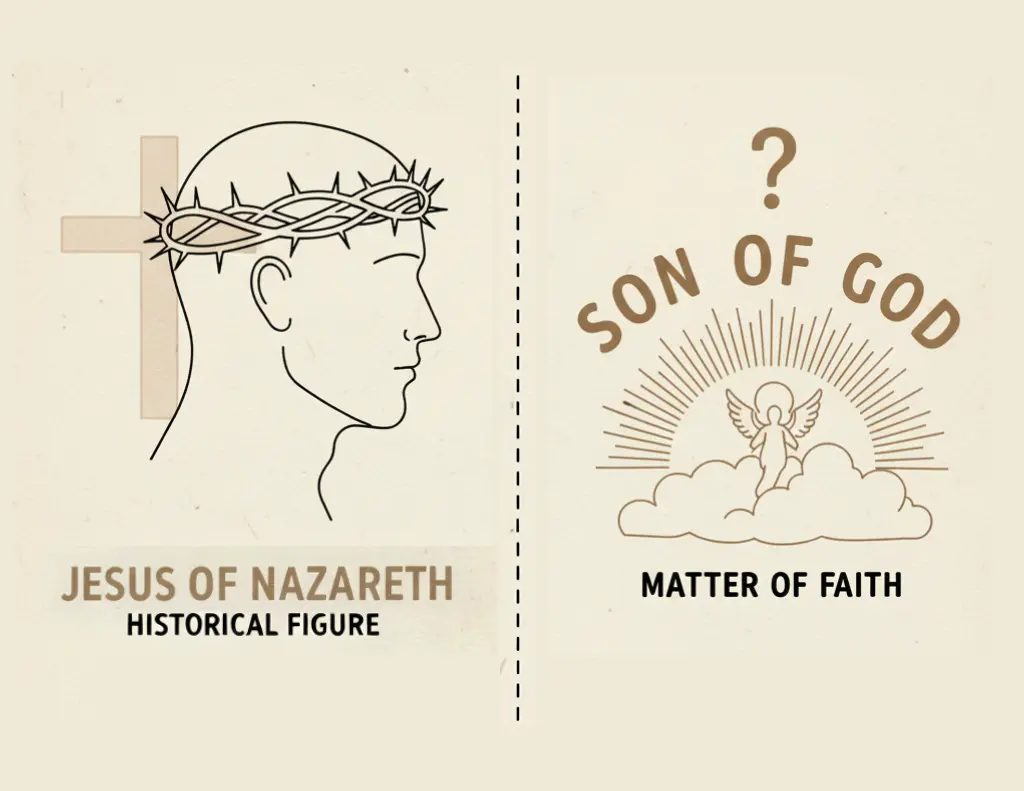
The question of whether Jesus existed is generally divided into two parts by historians: the “Jesus of history” (the man who lived in 1st-century Judea) and the “Christ of faith” (the Son of God as defined by Christian theology).
The overwhelming consensus among modern historians, both Christian and secular, is that Jesus of Nazareth was a real historical figure who lived and died in the first century.
However, the question of whether he was the “Son of God” is a matter of religious faith and theological interpretation, as the available historical evidence confirms his existence and certain facts about his life, but not his divine nature or miracles.
1. Evidence for the “Jesus of History”
Evidence for the historical existence of Jesus comes from both early Christian writings and non-Christian sources.
A. Non-Christian Sources
These independent accounts confirm several key historical facts about Jesus:
- Tacitus (c. 56–120 AD): This Roman historian, writing around 115 AD, mentions “Christus” (from whom Christians derived their name) being executed by the procurator Pontius Pilate during the reign of Tiberius. This confirms the time, place, and manner of his death.
- Josephus (c. 37–100 AD): This 1st-century Jewish historian mentions Jesus in his work Antiquities of the Jews. One reference mentions James as “the brother of Jesus, who was called Christ.” A longer passage, known as the Testimonium Flavianum, is widely believed by scholars to have been partially edited or embellished by later Christians, but the core reference to a wise man named Jesus who was crucified is generally considered authentic.
- Pliny the Younger (c. 61–113 AD): This Roman governor wrote a letter to Emperor Trajan around 112 AD, describing Christians who would meet to sing “a hymn to Christ, as to a god.” This confirms that early Christians were worshipping Jesus as a divine figure shortly after his lifetime.
- The Babylonian Talmud (Jewish rabbinic texts): Contains references to Jesus, generally hostile, acknowledging that he was executed on the eve of Passover.
B. Early Christian Sources (The New Testament)
The New Testament is the primary source of information, but historians differentiate between its theological claims and its historical content:
- Pauline Epistles (Letters of Paul): These are the earliest surviving Christian writings (dating from the 50s and 60s AD, only about 20–30 years after Jesus’s death). Paul claims to have met and interacted with eyewitnesses, including Jesus’s brother, James, and his closest disciples, Peter and John, treating Jesus as a real person.
- The Gospels: Matthew, Mark, Luke, and John are considered ancient biographies written in the style of the time, primarily focused on recounting the life, ministry, death, and resurrection of Jesus. Historians use various criteria (like the criterion of embarrassment—details embarrassing to the early church, like his baptism by John) to separate historical memory from theological tradition.
2. The Claim of “Son of God”
The claim that Jesus is the “Son of God” is a central element of Christian faith and is found throughout the New Testament, but it is not a claim that can be verified or refuted through standard historical and archaeological methods.
- Historical documents, including non-Christian ones, confirm the existence of a man named Jesus who was a teacher, had a following, and was crucified.
- The historical evidence also confirms that his followers almost immediately began worshipping him as divine (“Christ as to a god,” per Pliny) and that they believed in his resurrection (as implied by Tacitus’s mention of a “mischievous superstition… again broke out”).
In summary:
| Element | Historical Consensus |
|---|---|
| Jesus of Nazareth’s Existence | Yes (Overwhelming consensus among historians, based on multiple, independent, and early sources) |
| His Crucifixion under Pontius Pilate | Yes (Widely accepted historical fact) |
| His Identity as the “Son of God” | A matter of religious faith (Cannot be confirmed or denied by historical methodology) |
My Thoughts in a blockquote